Friday, 16 February 2018

Nighttime visitors to the allotment

For a long time I could only guess what is happening on the allotment in the night. I assumed there might be a hedgehog as I found faeces but never saw one. Until I got my wildlife cam.
This is a nice little waterproof camera which can be left outside where you want it, to capture images and videos of wildlife. The camera has a motion sensor which activates the camera as soon as something moves in front of it and an infrared beam for nighttime shots. I have programmed my camera to only activate during the night to avoid taking videos of all the birds frequenting my allotment during the day (at one time I had about 50 video clips of various blackbirds in just one day).
So thanks to my wildlife cam I now have a much better idea of all the nighttime visitors on my allotment.

So what did I find? Firstly, I was right, there really is a hedgehog visiting my plot. A nice healthy-looking one, coming nearly every night. The last time I have seen him on the camera was on the 24th of December which was quite a mild night. Apparently hedgehogs do not hibernate deeply but wake up now and again when it is milder to eat something and defecate. I also found out that hedgehogs don`t seem to like eating big slugs as in one video clip I could see quite a large slug which was completely ignored by the hedgehog.

My allotment hedgehog
This slug is completely ignored by the hedgehog
The hedgehog is snuffling around the compost area

 I made a little film about the hedgehog which you can watch below.


Other nighttime visitors are little wood mice which I am quite fond of now. Often you just see a pair of tiny glowing eyes first, before it becomes apparent that you are looking at a little mouse. They are very skittish, always expecting a predator behind the next bush. And they are right to be careful. In one of the video clips I saw a cat running off with one of my wood mice in its mouth, quite a disturbing sight!

A little wood mouse sitting on the compost heap

Below you can see a short video featuring the wood mice.


Which brings me to the next visitor, not a popular one with me (but cat lovers might disagree), namely cats! There are all sorts of cats on my plot at nighttime, black ones, brown ones, long-haired ones, fat ones, thin ones, you name it. Sometimes I think the whole neighbourhood cat population finds my plot irresistible. Poor little wood mice. At least the hedgehog does not seem to be bothered, he is well protected in his thorny coat.

Cat on the prowl, looking rather well-fed

A few times I have also had rabbits on my plot, but apart from digging shallow holes here and there they don`t seem to do a lot of damage. Not so on my allotment neighbours plot. He likes to grow parsnips and carrots and always leaves some in the ground to overwinter. I had a look last weekend, and what can I say, there is not much to harvest anymore. All the tops have been completely hollowed out, with tell-tale signs of rabbit poo nearby. It does not take much to name the culprit here.
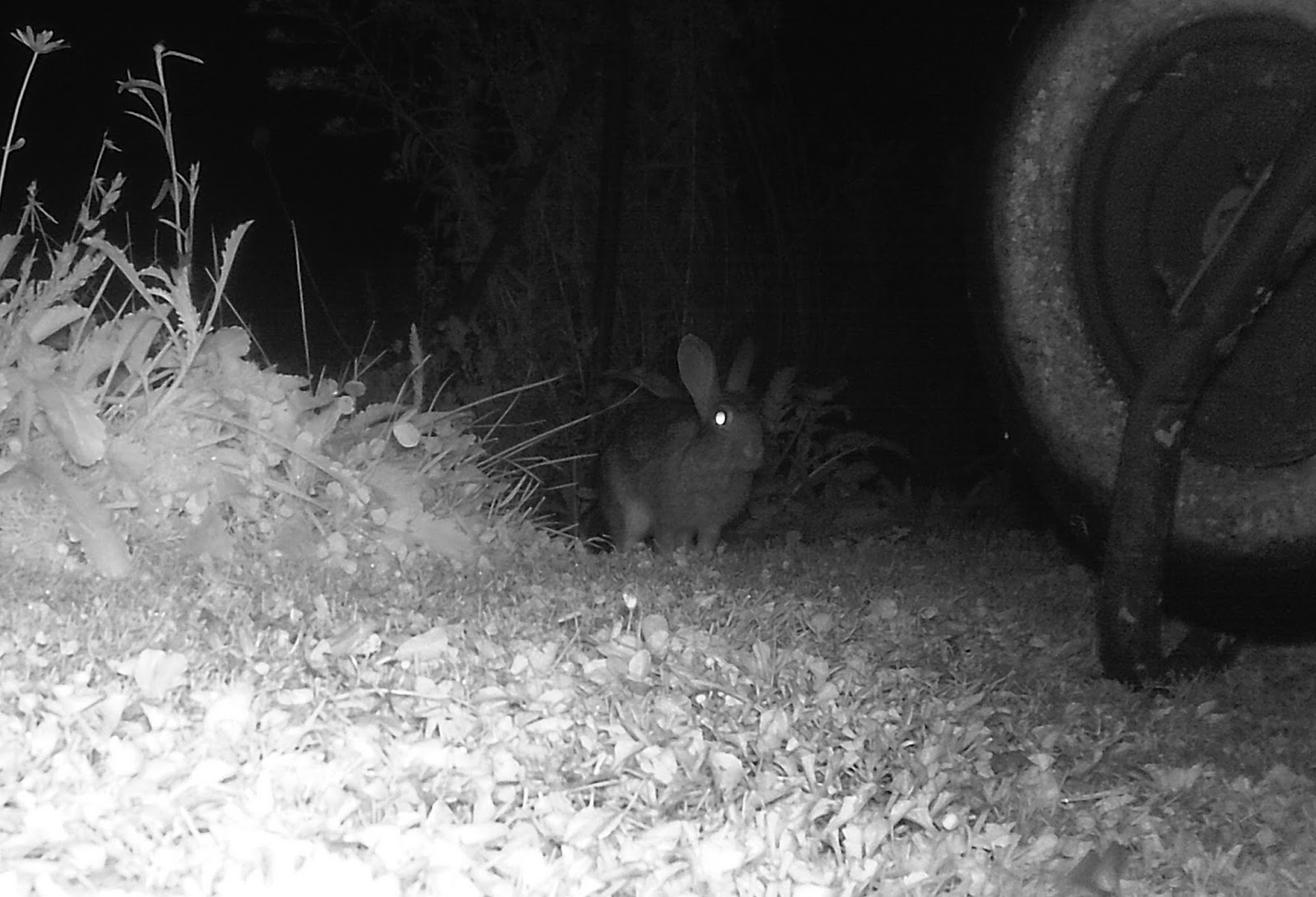
A rabbit on the way to my allotment neighbours carrots


Other visitors to my plot are wild rats. Some people now probably say: Yuck! Vermin! Kill them all! But I think they are part of the wildlife on the allotment site and have as much right to be there as the hedgehog and the wood mice. There are only a few, they don`t do any damage and they generally keep a low profile (it is very unusual to see them during the day). There is even the added bonus of quicker composting as the rats like to dig tunnels through the compost which helps with aeration and mixing.

One of the wild rats visiting my plot
One of my favourite rat images, a sweet little youngster eyeing up some treats

Last autumn I found some faeces which looked suspiciously like coming from a fox but so far I did not have one on my camera. I have seen one a few years ago when I was on the allotment very late, the wind was blowing towards me and the fox did not smell me. I kept very still and watched the fox walk past me only about 10 m away, an exhilarating experience. So there are foxes on the allotment site, I just need to get one in front of my camera. A little challenge I set myself this year. Watch this space to see if I am successful.

There is another little video I made with the hedgehog, little wood mice jumping around, the wild rats and a rabbit which can be watched below.


Wednesday, 7 February 2018

How to grow great celeriac

When I talk to other gardeners or look through gardening forums online I get the impression that many people find it difficult to grow decent-sized celeriac. I have to admit that I never had problems growing celeriac, mine typically weigh up to 800 or 900g at harvest, big enough to use for 2 meals for 2 people. If you struggle growing celeriac in your garden or on your allotment why not try out my way of growing this tasty vegetable?
 
1. Start early
Celeriac needs a long growing season and I always sow the new crop of celeriac when I harvest the last plants from the allotment, which means in a normal year mid-February. I sow the seeds under cover in good seed compost with a sprinkle of vermiculite on top and keep the seeds at about 15-20 C. After germination I wait until the first true leaves appear and then prick the young plants individually into plug trays. I transfer the young plants into 7 cm pots once they are large enough and plant them outside at the beginning of May (later if we have a cold spell).

2. Keep them warm
Celeriac likes it warm and will not appreciate if it is subjected to cold temperatures which will check the growth and might even initiate premature flowering. I keep my celeriac under cover for as long as possible (up to mid-May in colder years) and once they are planted out I protect the young plants with a layer of fleece until about mid-June.

3. Feed and water well
Celeriac needs rich soil which holds moisture well even in dry spells. I always add manure and home-made compost to the bed I have destined for celeriac. It is also important to water well in summer. In dry spells I water every 2-3 days. Once a week I feed the plants with home-made comfrey fertiliser (comfrey leaves fermented in water, 1 part smelly comfrey liquid mixed with 10 part water) which is very effective.

Celeriac happily growing away in July

4. Remove outer leaves in late summer and autumn
There is some controversy about this as it is not clear if removing the outer leaves in late summer and autumn really improves the swelling of the celeriac stem (the part we eat) but I always do this and my celeriac always have massive stems (not very scientific, I know!). Maybe in one of the next years, once I have more space, I will set up a little experiment with a proper control (no removal of outer leaves) so I can find out if there really is a difference. 

Celeriac in October, ready to harvest
 
5. Harvest, cook and enjoy
Celeriac is not completely winter-hardy but will sit happily outside through winter if you give it some protection with a double-layer of fleece. I normally harvest the last celeriac in February. They last several weeks in the fridge once harvested. Celeriac has a nice aromatic celery flavour, I use it together with potatoes as mash or in soups and stews.

Friday, 2 February 2018

Frosts and snowdrops: The allotment in January

January is a very quiet month on the allotment, not much is happening but it is a good time to prepare for the new growing season and to get ahead with things before the "madness" of spring starts.
As much as I love spring with all the new growth, seed sowing, buzzing bees and flowers opening everywhere, I also enjoy the down-time now which gives me time to think and plan ahead.


A frosty day on the allotment
Little blue stem (Schizachyrium scoparium) in the foreground, adding some colour to the allotment

I have mainly been emptying the composters at the beginning of January and spreading the compost onto the flower beds. I have 8 composters now which give me a nice amount of my own compost. I use it mainly for the perennials as it is much easier to spread than the manure and not smothering any plants. The only downside is that I am also spreading annual flower seeds around as the composters don`t get hot enough to kill the seeds. Nigella and Calendula are a bit of a nuisance sometimes and I have to remove most of the seedlings to protect my perennial plants from being overwhelmed. But I always leave a few as I like their cheery flowers.  I was also shifting the manure which went onto the beds destined for growing pumpkins & squashes, potatoes, tomatoes, beans and sweetcorn.

Echinacea purpurea seed head

Perennials hardening-off in the cold frame
On milder days I have planted perennial flowers and grasses in the new flower beds. I grew most of the perennials from seed last year and hardened them off in the 2 cold frames I have on the allotment.
The new steppe planting is nearly finished now, one of my favourite areas on the allotment. It will be very exciting to see it develop in the next years. I planted Kniphofia Euphorbia epithymoides, Ratibida columnifera, Inula ensifolia, Pulsatilla vulgaris, various Eryngium, Echinacea pallida & purpurea, Phlomis cashmeriana, Tulipa praestans and the grasses Koeleria glauca, Melica ciliata, Bouteloua gracilis, Schizachyrium scoparium and Festuca glauca. I still have to plant Asclepias tuberosa and Geum triflorum. I will cover the area with sand and gravel to mainly keep the slugs away as apparently Asclepias tuberosa and some of the other plants such as Ratibida are very palatable to slugs. It also looks nice.

The new steppe planting area
Another new planting on the allotment
Me explaining a new planting to my partner

I have put some bird feeders out last autumn and since then there is a constant stream of birds, mainly blue tits, great tits, long-tailed tits and my allotment robin, filling their bellies with tasty peanuts and nourishing fat. It is a joy to watch them, busily flying back and forth between my feeders and the nearby hedge.

A great tit and two long-tailed tits visiting my bird feeders

The first crocuses
One of the highlights of January was the appearance of the snowdrops, crocuses, Cyclamen coum and winter aconites. I saw the first crocus flowers on the 12th of January, the earliest I have ever seen them flowering (see also my earlier blog post here). The snowdrops seem to be spreading slowly and some appeared in places I have never planted them. Snowdrop seeds have an attachment called elaiosome containing fats and proteins, which ants find irresistible and carry off down their tunnels to feed to their larvae. This successfully distributes the seeds to new locations which explains my spreading snowdrop population. Cyclamen seed are distributed in the same way.


Cheerful winter aconites
Snowdrops nod their heads in the light breeze
Frosted Cyclamen coum flowers

It always lifts my spirits to see these hardy flowers in the middle of winter, adding a splash of colour to the mainly green, brown and grey colour palette. It is also a sign that spring is not too far away now.

The allotment at the end of January

Wednesday, 24 January 2018

Are the crocuses on my allotment flowering earlier every year? - a scientific investigation (of sorts)

12 January 2018
This is a question I am asking myself for quite a while now as it feels like I am seeing the first crocus flowers earlier and earlier each year. To answer this question I went back to the photos I have taken each year of my allotment. As the first flowers are always eagerly anticipated I normally take photos of the first crocuses and snowdrops I can see each year so I have a pretty good photo record of these flowers from 2012 until now.


First crocus flowers seen on my allotment

As you can see in the graph above, in 2012, 2013 and 2015 I recorded the first crocus flowers in mid February. In 2014 the first crocus flowers were out at the beginning of February. In 2016 and 2017 the flowers opened towards the end of January and this year I have seen the first crocus flowers on the 12th of January!
Having the dates of first flowering for seven consecutive years, I was actually able to test the above question statistically, with a so-called Spearman rank correlation test. Using the one-sided version of this test, which specifically asked the question 'Has flowering begun increasingly earlier throughout the period  2012-2018?', I could confirm  this with a probability of 99.91%, corresponding to a P-value of 0.0009 in the statistical test, which is considered a highly significant result in statistical terms. To answer the question in the title, yes, crocuses tend to flower earlier every year on my allotment, even though 2015 appeared to represent a bit of a blip.

16 February 2013

2 February 2014
I am not the only one recording earlier flowering dates for plants. A study derived a 250-year index of first flowering dates for 405 plant species in the UK and found that British plants are flowering earlier now than at any time in the last 250 years. As there is a strong correlation between temperature and the date when flowers first open each year we can assume that our climate is getting warmer.

24 January 2016
22 January 2017

Thursday, 18 January 2018

The 10 best plants for pollinators on my allotment

Every year I grow lots of different flowers on my allotment. Most of them attract at least some pollinators but others are so attractive that they are often covered in bees, butterflies, hoverflies and other pollinators on a sunny warm day. A few plants I grow attract very specific pollinators such as campanulas (especially Campanula rotundifolium and C. persicifolium) which attract the harebell carpenter bee (Chelostoma campanularum) and some of my herbaceous potentillas which seem to attract only social wasps, but this may be a topic for another blog post. Here I want to show some of the plants on my allotment which attract a wide range of different pollinators, all well-worth growing in your garden if you want to help pollinators.

1. Crocus

One of the best plants for early bees and flies in late winter/early spring are the various crocuses I grow. I have mainly Crocus crysanthus and Crocus tommasinianus which flower late January and in February. On a warm day newly emerged bumblebee queens seek out the flowers, I have also seen drone flies (Eristalis spp.), hairy-footed flower bees (Anthophora plumipes) and other early solitary bees such as mining bees (Andrena spp.).


2. Poached Egg Plant (Limnanthes douglasii)

Poached egg plants are annuals but you only have to sow them once and they will come back year after year as they self-sow prolifically but never get out of hand. They normally flower in May and provide a welcome splash of colour and a good food-source for bees, hoverflies, other flies and beetles. On warm sunny days in May I often lie in wait with my camera near a patch of flowers to take photos of visiting pollinators, I never have to wait long until something arrives.


3. Ornamental Alliums

I grow various different ornamental alliums, from early alliums such as Allium roseum and Allium `Purple Sensation` to later alliums such as Allium sphaerocephalum, A. moly and A. caeruleum. All are good for pollinators and are easy to accommodate as you only have to remember to plant the bulbs in autumn. They all like sunshine and most of them will come back year after year if planted in well-drained soil. The main flower visitors seem to be bumblebees but I have also seen solitary bees on some of the earlier alliums, especially Allium roseum.


4. Cosmos

I grow Cosmos bipinnatus and C. sulphureus on my allotment. Both are annuals and have to be raised from seed every year. Both sometimes self-sow but I find that often the seedlings germinate too early and are killed off by late frosts. For this reason I always make sure I collect seeds in autumn and sow them under cover in April to plant out in mid-May. The plants grow in any good garden soil and like full sunshine. The flowers attract mainly bumblebees, solitary bees and butterflies.


5. Giant Hyssop (Agastache spp.)

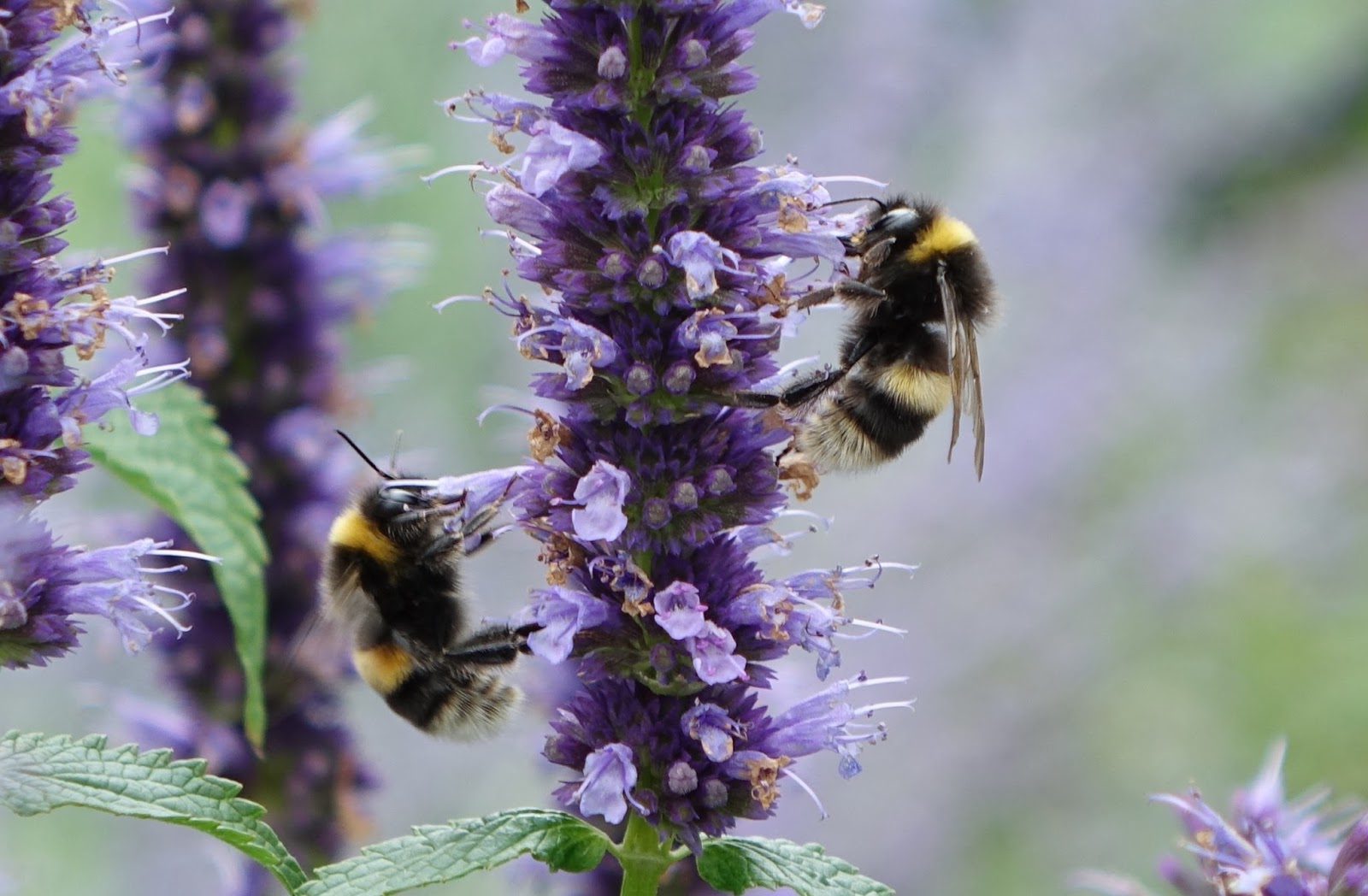
Many agastache are border-line hardy or have to be treated as annuals but a few are winter-hardy in the UK. I grow Agastache foeniculum (also called anise hyssop) which is fully winter-hardy on my allotment. Raising the plants from seed is easy if you have a greenhouse, otherwise you can find plants in most nurseries or online. Agastache likes full sunshine and well-drained soil, wet feet in winter will most likely kill the plant. It flowers in summer and is very attractive to bumblebees; it is a joy to watch all the busy bees collecting pollen and nectar on a sunny day.


6. Viper`s bugloss (Echium spp.)

Most echiums are biennial plants, they grow a rosette in the first year and a tall flower spike in the second. This is certainly the case for our native purple viper`s bugloss, Echium vulgare. There are a few perennial echiums such as Echium amoenum which comes from the Caucasus, but it is difficult to keep the plants alive in our wet winters. There are a few very attractive border-line hardy echiums from the Canary Islands such as Echium wildpretii and E. pinninana but they only survive outdoors in very sheltered gardens. Apart from the native Echium vulgare I have also grown Echium wildpretii which I raised from seed. I  kept the plants in a greenhouse in the first year and planted them outside in mid-May in the second year. The flower was spectacular (see pictures on the right and below) but it really is a lot of effort. This year I am trying out Echium pinninana, also grown from seed. I currently have large plants in the greenhouse and will plant them out in May. The flowers can be up to 4m tall!
 

If you don`t have a greenhouse and/or the time for the border-line hardy echiums it is easiest to grow our native Echium vulgare. You can sow the seeds directly outside, best in summer to give the plants time to establish before they flower in the next year. All echiums are great for bumblebees.


7. Poppies (Papaver spp.)

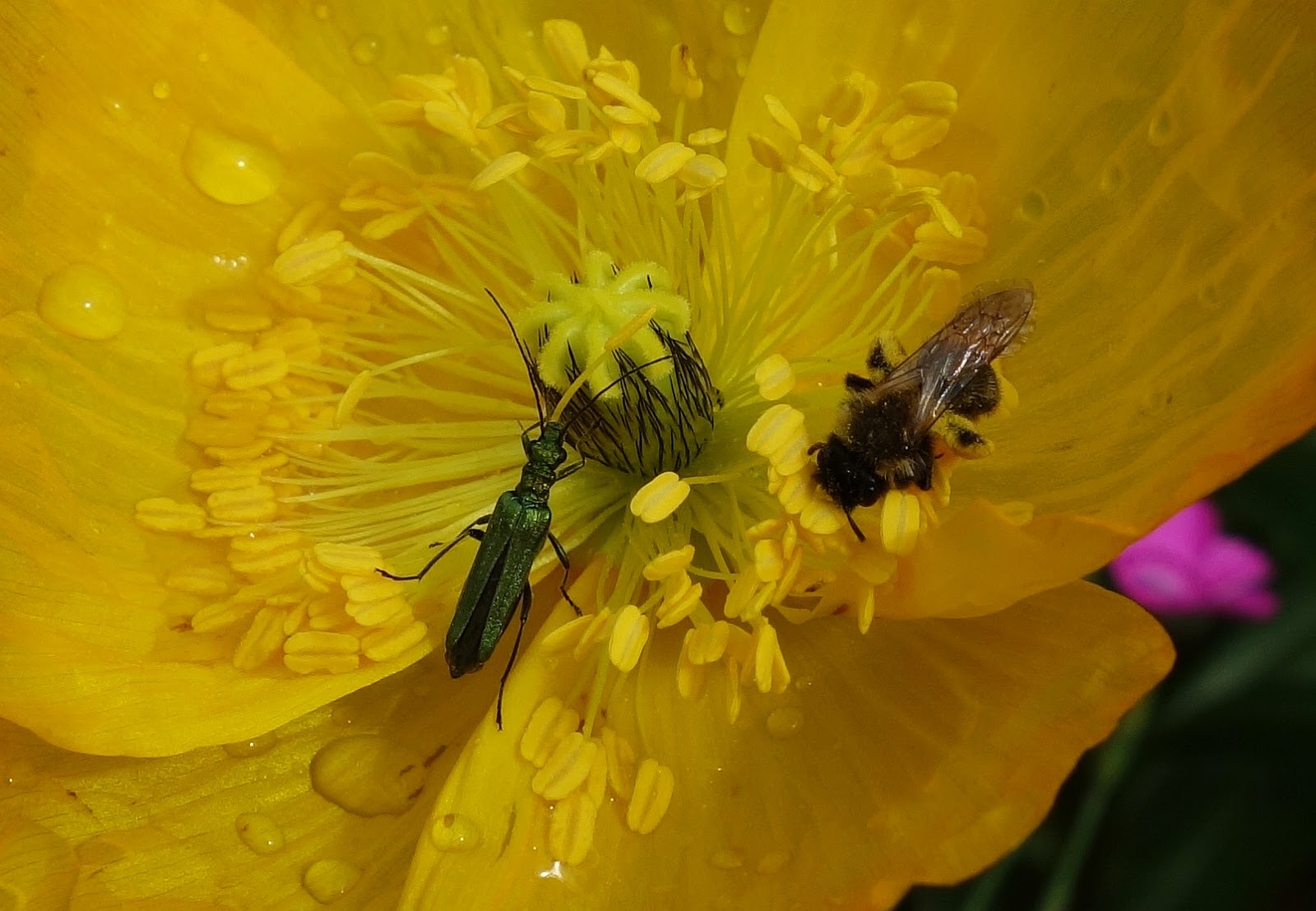
Poppies are easy to grow, cheerful early summer flowers, most are annual or short-lived perennials but a few, such as oriental poppies (Papaver orientale), are long-lived perennials. I grow a selection of poppies, from annual corn poppy (Papaver rhoeas), to short-lived arctic poppy (Papaver nudicaule) and long-lived oriental poppy (Papaver orientale). It is quite interesting that poppy flowers do not provide any nectar for pollinators but the flowers are nevertheless very attractive as the pollen is very protein-rich and produced in such abundance that especially bees cannot resist. Bumblebees have a special trick to collect the pollen which is called buzz pollination. As soon as the bees land in a poppy flower they start to vibrate their flight muscles very rapidly to dislodge the pollen from the anthers. You can hear this if you stand close to a poppy flower with a bumblebee inside as a high-pitched buzzing sound.


8. Wild marjoram (Origanum vulgare)

Probably one of the best plants for pollinators, wild marjoram is easy to grow in any good, well-drained garden soil in full sunshine. The tiny flowers produce a large amount of nectar which is highly attractive to all sorts of pollinators. Solitary bees, bumblebees, hoverflies, other flies, wasps, moths and butterflies all visit the flowers, and often they are so occupied with drinking nectar that I can get quite close to them to take photos.


9. Thistles (e.g. Cirsium spp., Carduus spp.)

Thistles are often seen as a weed and some can certainly be a nuisance but there are many very pretty and well-behaved thistles which are worth growing in a garden. I have to admit that I have a soft spot for thistles and have grown quite a lot now on my allotment. The thistles I have tried out but which I have not continued growing for various reasons are milk thistle (Silybum marianum) which was too prickly, nodding thistle (Carduus nutans) which is pretty but grew too large, woolly thistle (Cirsium eriophorum) which was too large and died after flowering, and purple milk thistle (Galactitis tomentosa) which is pretty but not winter-hardy here in UK so has to be grown from seed every year. The thistles I am still growing and can wholeheartedly recommend are our rare native tuberous thistle (Cirsium tuberosum) and Cirsium rivulare `Atropurpureum`. I am trying out a new thistle this year, Cirsium nipponicum from Japan, hopefully a good one.
All thistles are great plants for pollinators, especially bumblebees and butterflies seem to like the flowers but I have also seen solitary bees, beetles and hoverflies visiting.


10. Asters

Asters (also called michaelmas daisies) are one of the main stars of the autumn garden. There are a few spring-flowering asters such as Aster tongolensis but most asters flower from late summer until the first frosts. I grow many different asters such as Aster amellus, Aster x frikartii, Aster `Little Carlow`, New York aster (Symphyotrichum novi-belgii), New England aster (S. novi-angliae) and fragrant aster (S. oblongifolius). All asters are good pollinator plants, some are more attractive to pollinators than others but you cannot really go wrong if you stick to the asters with the more simple flowers. I mainly see late bumblebees such as common carder bumblebees (Bombus pascuorum) and late butterflies such as the admiral visiting the flowers.


New Wildlife Allotment blog

 I have started a new monthly blog about my wildlife allotment a few years ago for the Hardy Plant Society. I you are interested you can rea...

Popular Posts