Spring has arrived on the allotment. After coming back from a week's
holiday to Gran Canaria in the second half of March I was surprised to
find the allotment so much greener and with flowers opening everywhere.
Many of the perennials are coming back to life now and often the first
thing I do when visiting the allotment is to walk around all three plots
to look for new signs of life. It feels a bit like greeting old friends
after you have not seen them for a while. I am also very much looking
forward to seeing all the new plants starting into growth as I have
grown most of them from seed and only planted them out in autumn and
winter last year...
Read more in my Hardy Plant Society blog post

Friday, 12 April 2019

Tuesday, 9 April 2019
Wild tulips: Beauties of the early spring garden
 I planted a lot of spring bulbs on the allotment such as crocuses, daffodils, hyacinths and anemones. But the spring bulbs I love most are the wild tulips. I have now started
a small collection as my allotment suits them well with lots of
sunshine and well-drained soil. The first tulip to flower each year,
often as early as early March, is Tulipa turkestanica with pretty
white flowers with a yellow centre. I planted the bulbs in one of my
steppe plantings. They like the sandy well-drained soil and come back
every year.
I planted a lot of spring bulbs on the allotment such as crocuses, daffodils, hyacinths and anemones. But the spring bulbs I love most are the wild tulips. I have now started
a small collection as my allotment suits them well with lots of
sunshine and well-drained soil. The first tulip to flower each year,
often as early as early March, is Tulipa turkestanica with pretty
white flowers with a yellow centre. I planted the bulbs in one of my
steppe plantings. They like the sandy well-drained soil and come back
every year. |
| Tulipa turkestanica |
 |
| A fly is eating some pollen from a Tulipa turkestanica flower |

 |
| The flowers of Tulipa tarda only open in sunshine |
 Tulipa praestans
'Fusilier', another beautiful tulip from Central Asia, is starting to flower in mid March. The colour of the flowers is a pure glowing red which
stands out from the surrounding green even from far away. The plants are
growing in loamy soil with some sand and gravel mixed in. I love these
tulips so much that I planted some more last autumn in a different area.
Tulipa praestans
'Fusilier', another beautiful tulip from Central Asia, is starting to flower in mid March. The colour of the flowers is a pure glowing red which
stands out from the surrounding green even from far away. The plants are
growing in loamy soil with some sand and gravel mixed in. I love these
tulips so much that I planted some more last autumn in a different area. |
| Tulipa praestans flowers stand out from the surrounding vegetation |
 |
| Tulipa praestans has beautiful red flowers |

 |
| Tulipa sylvestris has slightly nodding flowers |
 |
| Tulipa sylvestris |
 |
| Tulipa saxatilis |
There are many more wild tulips and I try to add a few more each year to my growing collection. In Germany I have also grown Tulipa clusiana which has yellow and red or white and red flowers on tall stems and likes sandy soil.
 |
| Tulipa humilis |
 |
| Tulipa clusiana |
I have also sown the seed of Tulipa sprengeri, a tall red-flowered tulip, The seeds need stratification and are currently in the fridge as they only germinate after experiencing several month of cold temperatures. Tulipa sprengeri bulbs are very difficult to buy as they are not produced commercially. Occasionally the bulbs are offered by private growers and are sold out very quickly.
Wild tulips come from mountainous areas with temperate climates, where they are a common element of steppe and winter-rain Mediterranean vegetation. They thrive in climates with long, cool springs and dry summers which we increasingly seem to get here in the South of Oxfordshire. As most wild tulips come from open habitats such as steppes and meadows they need to be planted in full sunshine. Tulipa sprengeri is the one exception as it likes the cool shade under decidous trees. The soil needs to be free-draining and not too fertile. Otherwise wild tulips don`t need much care and when happy come back every year.
 |
| Tulipa saxatilis has broad leaves and pink flowers |
Bees especially solitary bees, and other early pollinators such as hoverflies, like to visit the flowers so these tulips are a good addition for a wildlife garden.
Best planting time is autumn and early winter, so don`t forget to order some this summer so you can enjoy some early spring colour next year.
Thursday, 28 February 2019
Crocuses and bumblebees
 Spring has started early this year. We already had temperatures of about 20 C, and we are still in February! The warm sunshine has brought out the bumblebees. The first to emerge are the queens which will be very hungry after hibernation. The first thing the queens will do after emerging is looking for food to fill their empty stomachs. Not many plants flower at this time of year but normally there are always some dandelions, lesser celandine and cherry plum flowers to be found.
Crocuses are good pollinator plants as well, offering pollen and nectar which also attract other early pollinators such as solitary bees and hoverflies.
 |
| A carpet of yellow and purple crocuses |
 |
| Buff-tailed bumblebee queen |

Often the queens are starved and weak after hibernating for months, crawling from flower to flower instead of flying, getting stronger while drinking the nectar. Once the stomach is full they will start searching for suitable nesting sites but not without frequently coming back to my crocuses to fill up again on the sweet nectar.
 |
| Hungry bumblebee queen |
 |
| Often, freshly emerged queens are quite weak and need food quickly |
 | |
| Two red-tailed bumblebee queens |
If you don`t have crocuses in your garden plant some! They are pretty, easy to please and good for pollinators. Best planting time is from September to November. They like sunshine but also grow in half-shade. Crocuses don`t need any watering or other care, these little flowers pretty much look after themselves. What more can you wish for. And don`t forget to look for bumblebee queens in early spring!
 |
| A white-tailed bumblebee queen |
 |
| Plant crocuses and the bumblebees will come |
 |
| This queen has found the crocus growing in my raised bed |
Saturday, 2 February 2019
Hungry birds and snowdrops
We don`t often see snow here in the South of England, but on Friday morning I awoke to a winter wonderland outside the window. The allotment has all but disappeared under a blanket of snow and only the taller vegetation such as grasses and seed heads are visible.
Snowdrops are now slowly appearing again from the snow thanks to some sunshine. They are tough little flowers and seem to be able to cope with any amount of frost and snow. They look like as if nothing has happened, their little flowers standing proud, ready to open once warmer weather arrives.


Many birds are very hungry as they cannot find any food in the snow and on frozen ground. Luckily I have put out some bird food for them; peanuts, fat blocks and fat balls. Nobody else on my allotment site seems to feed the birds so they all come to my feeders. Even the robin, who normally feeds on the ground, was hungry enough to fly up to the peanut feeder today. Blue and great tits as well as the cute long-tailed tits visit frequently, the dunnocks hop around on the ground, searching for spilled food. Occasionally I even have a Great-spotted woodpecker visiting.


The snow is also revealing some night-visitors to the allotment thanks to the footprints they have left behind. The foxes seem to have been very active, probably looking for food. I wonder what they eat when the ground is frozen and covered by a blanket of snow. I have also seen some muntjac deer footprints and a few rabbits.
 |
| The allotment covered with a blanket of snow |
 |
| Grasses and seed heads are still visible |
 |
| The pond with the remains of the snow fox in the foreground |
Snowdrops are now slowly appearing again from the snow thanks to some sunshine. They are tough little flowers and seem to be able to cope with any amount of frost and snow. They look like as if nothing has happened, their little flowers standing proud, ready to open once warmer weather arrives.


 |
| Acrobatic blue tit |
 |
| The robin managed to fly up to the peanut feeder |
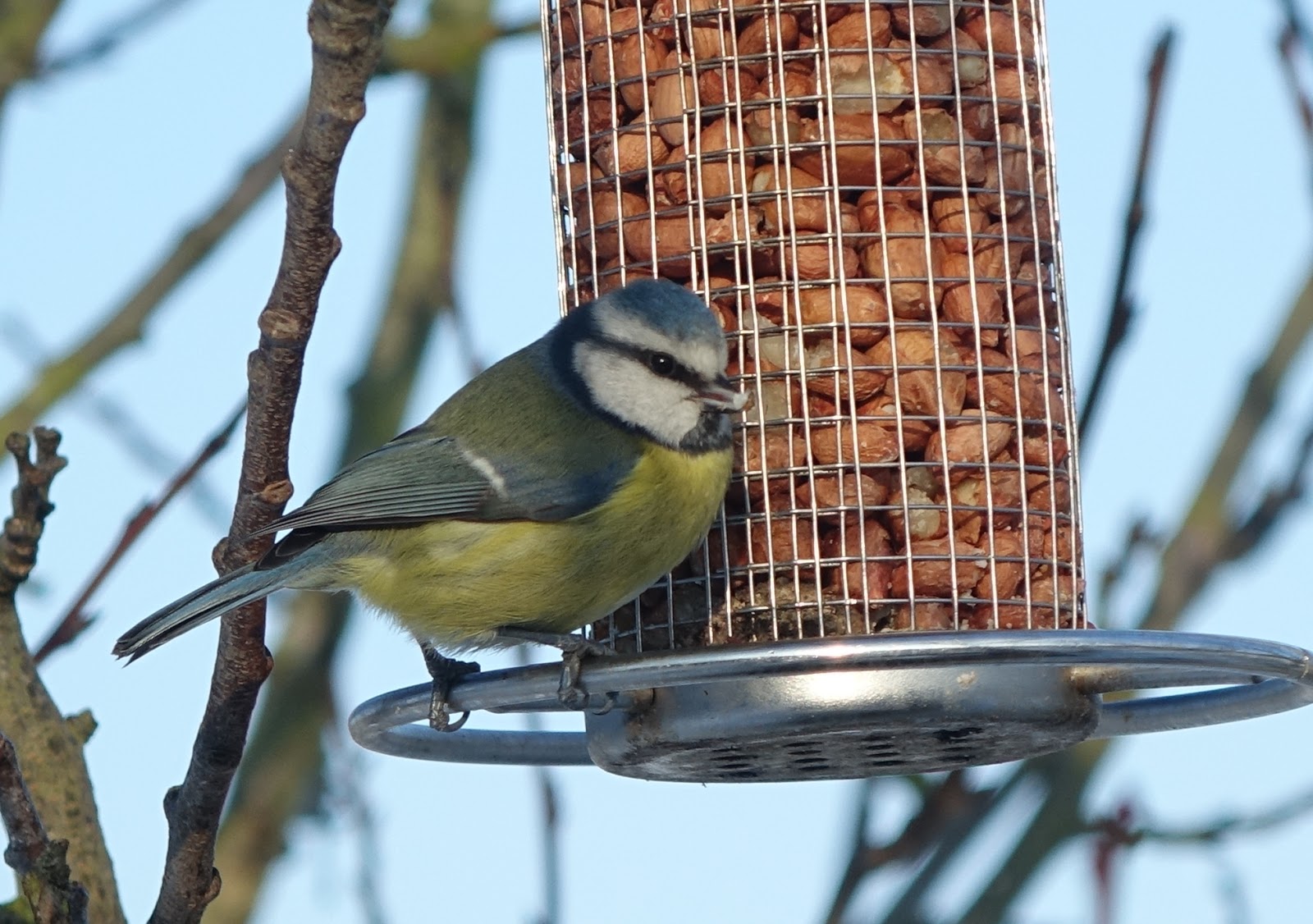 |
| Blue tits like the peanuts |
 |
| The robin looking slightly grumpy |

 |
| Cute little long-tailed tit |

 |
| Bird footprints on the frozen pond |
 |
| A dunnock searching for food |
 |
| Robin and long-tailed tit sharing the fat block feeder |
 |
| The dunnocks are normally very shy and difficult to photograph |

The snow is also revealing some night-visitors to the allotment thanks to the footprints they have left behind. The foxes seem to have been very active, probably looking for food. I wonder what they eat when the ground is frozen and covered by a blanket of snow. I have also seen some muntjac deer footprints and a few rabbits.
 |
| A fox footprint |
 |
| A fox has walked here last night |
Monday, 28 January 2019
My new adventure with unusual fruit and veg
 This year I will start a new adventure. I
got a book about unusual fruit and vegetables as a Christmas present which got
me very excited about trying to grow some new edible plants. Why grow endless rows of cabbages, onions and potatoes when you can buy this staple food cheaply at the supermarket. I thought it is probably a better use of space to mainly grow things which I cannot buy, things which taste much better when I grow them myself and things I like but which are expensive to buy such as a lot of the soft fruit.
This year I will start a new adventure. I
got a book about unusual fruit and vegetables as a Christmas present which got
me very excited about trying to grow some new edible plants. Why grow endless rows of cabbages, onions and potatoes when you can buy this staple food cheaply at the supermarket. I thought it is probably a better use of space to mainly grow things which I cannot buy, things which taste much better when I grow them myself and things I like but which are expensive to buy such as a lot of the soft fruit.
I now made a list of unusual fruit and veg I will try this year. I will assess my success in autumn and keep growing what worked well and what I like and replace other things which did not work or I did not like with new things.
There are some interesting annuals and tender perennials which I will try this year. I bought seeds of Asparagus pea which not only has pretty flowers but has edible pods as well. Oca is a tender tuber belonging to the Oxalis family which tastes similar to potatoes but with a more lemony flavour. It needs a long growing season and I hope the longer autumns we seem to get now will suit it. I will also try New Zealand spinach which is drought-resistant, an essential requirement on my allotment as we seem to get hotter and dryer summers. Chinese violet cress (Orychophragus violaceus) has edible leaves, flowers and stems and grows as a biennial. Litchi tomato (Solanum sisymbriifolium) is actually a fruit which is apparently quite tasty but also very prickly, so it needs to be harvested very carefully.
 |
| Chinese Artichoke tubers |
Many of these
unusual edibles are hardy perennials. Chinese artichoke (Stachys affinis) has edible tubers and pretty flowers in summer. The tubers can be lightly steamed and buttered and have a nutty flavour. Babington`s leek (Allium ampeloprasum) can be used as a perennial garlic, the leaves are edible as well. Hooker`s onion (Allium acuminatum) is a pretty allium with edible leaves, roots and flowers which taste of onions.
Earth chestnut (Bunium bulbocastanum) is grown for its tasty roots,
Winter purslane (Claytonia perfoliata)
and Scotch lovage (Ligusticum scoticum) have edible leaves, the former used in salads and the latter as a spice in soups and stews with a taste similar to lovage and celeriac.
These hardy perennials are quite easy to grow as you just have to plant them, keep them weed-free and harvest whenever it is convenient.
 |
| Earth chestnut (Bunium bulbocastanum) |
 |
| The Asian pear is planted |
Other new fruit I will try are Chilean guava (Ugni molinae) which is hardy down to -10 C, Nanking cherry (Prunus tomentosa) with fruit similar to sour cherries, just a bit sweeter, and Asian pear (Pyrus pyrifolia) which apparently tastes like a combination of pear and apple. All of these are planted now.
 |
| A variegated variety of Chilean guava (Ugni molinae) |
I have now also ordered a Persimmon 'Nikitas Gift' which is completely winter-hardy and has apple-sized orange fruit which are quite sweet, a Japanese plum 'Satsuma' with dark red fruit and Carolina allspice (Calycanthus floridus) from which I can make a cinnamon-like spice.
I have already planted a Loquat (Eriobotrya japonica)
which I have grown from seed I collected on the Canary Islands. I love the fruit which look a bit like apricots and have an amazing flavour, like a pleasant blend of apricot, plum and cherry. I am not sure
if it will ever fruit here in the UK but with its large hairy evergreen leaves
it looks ornamental enough to warrant a place on my allotment even without the
added bonus of fruit.
 |
| My new Loquat tree |
There is also a nectarine planted on the allotment now which I have grown from a supermarket fruit. Unlike apples, plums and pears, nectarines and peaches come true from seed. It is a pretty little plant with a nice autumn colour, I might even get some fruit one day. I have also grown a pomegranate which will be planted in spring. Pomegranate grows as a small bush and has nice flowers. The plant is hardy down to about -5C but I will probably never have fruit here in the UK. But with climate change you don`t know what will happen in the future.
I will post regular updates over the next years about all the new fruit and veg I am growing, also taste tests and how hardy things are. So watch this space!
Update: The first report on oca and Chinese artichoke can be found here.
Update: The first report on oca and Chinese artichoke can be found here.
Subscribe to:
Posts (Atom)
New Wildlife Allotment blog
I have started a new monthly blog about my wildlife allotment a few years ago for the Hardy Plant Society. I you are interested you can rea...

Popular Posts
-
 Most people grow certain plants because they have nice flowers or pretty leaves, but not many people choose plants for their seed heads in a...
 -
 Every year I grow lots of different flowers on my allotment. Most of them attract at least some pollinators but others are so attractive tha...